> For the complete documentation index, see [llms.txt](https://help.clausebuddy.com/llms.txt). Markdown versions of documentation pages are available by appending `.md` to page URLs; this page is available as [Markdown](https://help.clausebuddy.com/admin/faq/how-do-i-delete-a-user.md).
# How do I delete a user?
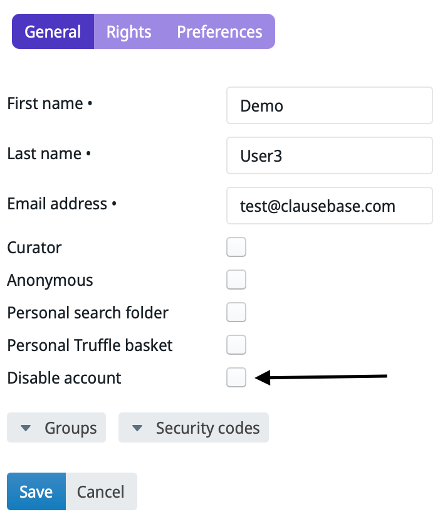
You will notice that there is no ‘delete user’ function. To remove a user from ClauseBuddy, you need to disable them. You can do this by clicking on the relevant name in the user overview and checking ‘disable user’. The user will no longer have access or be visible:
You may wonder why this is necessary – it relates to the fact that users, upon creating clauses, templates, or other material within ClauseBuddy, become owner of that material. Deleting the user would also mean deleting the owner.
You could transfer ownership of the material to a different user but then this also paints an incorrect picture – suddenly, this other user is considered the owner when they didn’t have a hand in creating the clause. It may be far better to still be able to see who the original author/owner was, even if that person has left the organisation or no longer has a ClauseBuddy account. Disabling this user allows just that.
Naturally, disabled users do not count towards your user limit.
---
# Agent Instructions
This documentation is published with GitBook. GitBook is the documentation platform designed so that both humans and AI agents can read, navigate, and reason over technical content effectively. Learn more at gitbook.com.
## Querying This Documentation
If you need additional information that is not directly available in this page, you can query the documentation dynamically by asking a question.
Perform an HTTP GET request on the current page URL with the `ask` query parameter, and the optional `goal` query parameter:
```
GET https://help.clausebuddy.com/admin/faq/how-do-i-delete-a-user.md?ask=&goal=
```
`ask` is the immediate question: it should be specific, self-contained, and written in natural language.
`goal` is optional and describes the broader end goal you are ultimately trying to accomplish on behalf of the user. GitBook uses it to tailor the answer towards what is most useful for that goal.
The response will contain a direct answer to the question and relevant excerpts and sources from the documentation.
Use this mechanism when the answer is not explicitly present in the current page, you need clarification or additional context, or you want to retrieve related documentation sections.