> For the complete documentation index, see [llms.txt](https://help.clausebuddy.com/llms.txt). Markdown versions of documentation pages are available by appending `.md` to page URLs; this page is available as [Markdown](https://help.clausebuddy.com/quality-library/how/in-depth/custom-styling/clausebuddy-layout-structure.md).
# ClauseBuddy layout structure
ClauseBuddy (and Clause9) offers a refined layout structure, that is probably be much more flexible than your house style in some areas.
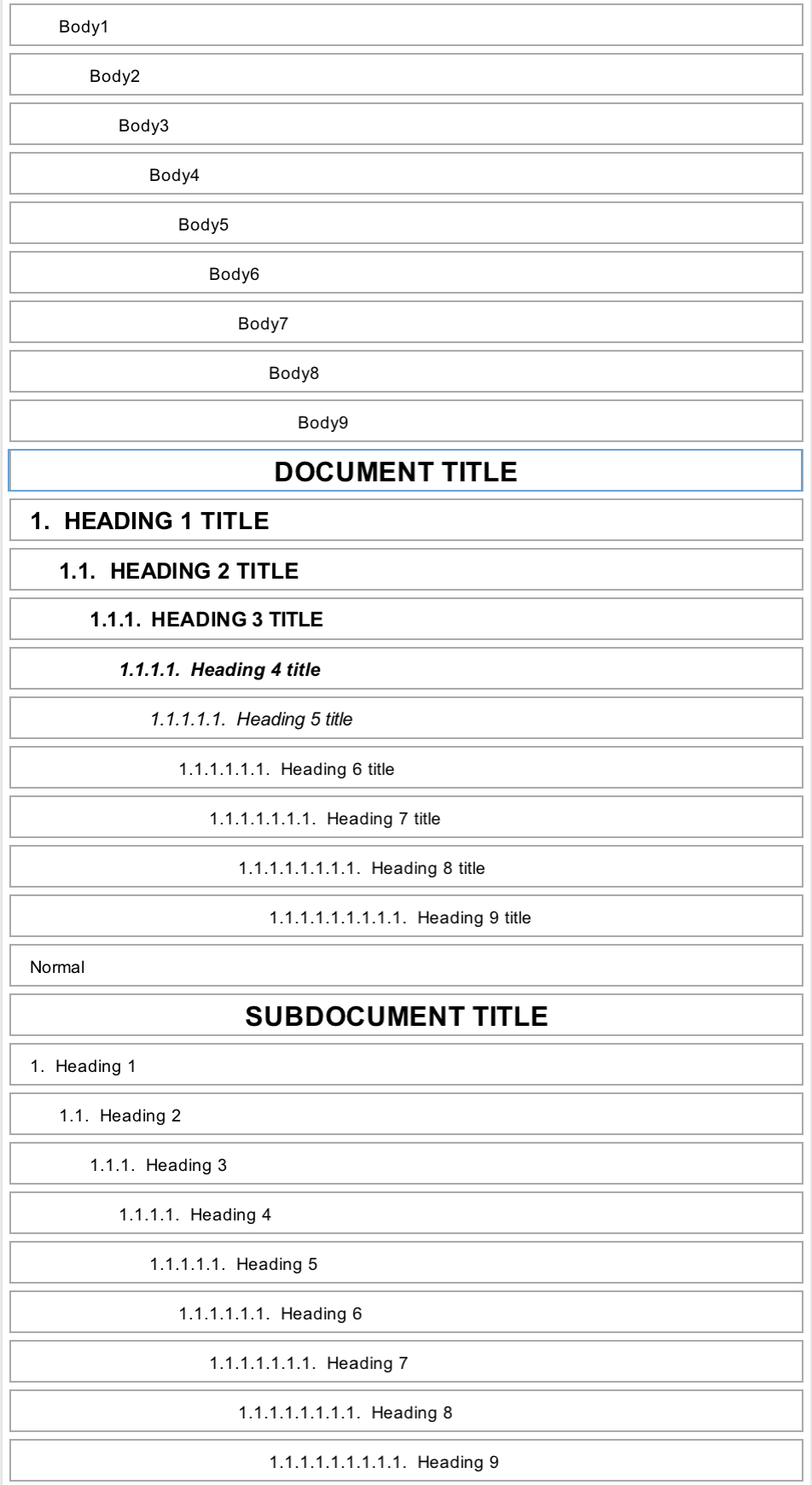
Essentially, the ClauseBuddy layout structure is subdivided into nine different **levels**. On each level, you can encounter a **title** style (typically bold and/or coloured), a **heading** style and up to nine different **body** styles. Each title and heading can have a **number**, while each body paragraph can optionally have a bullet. Finally, there is also a separate style for the **title of the (sub)document** itself.
ClauseBuddy's Word style structure thus look as follows:
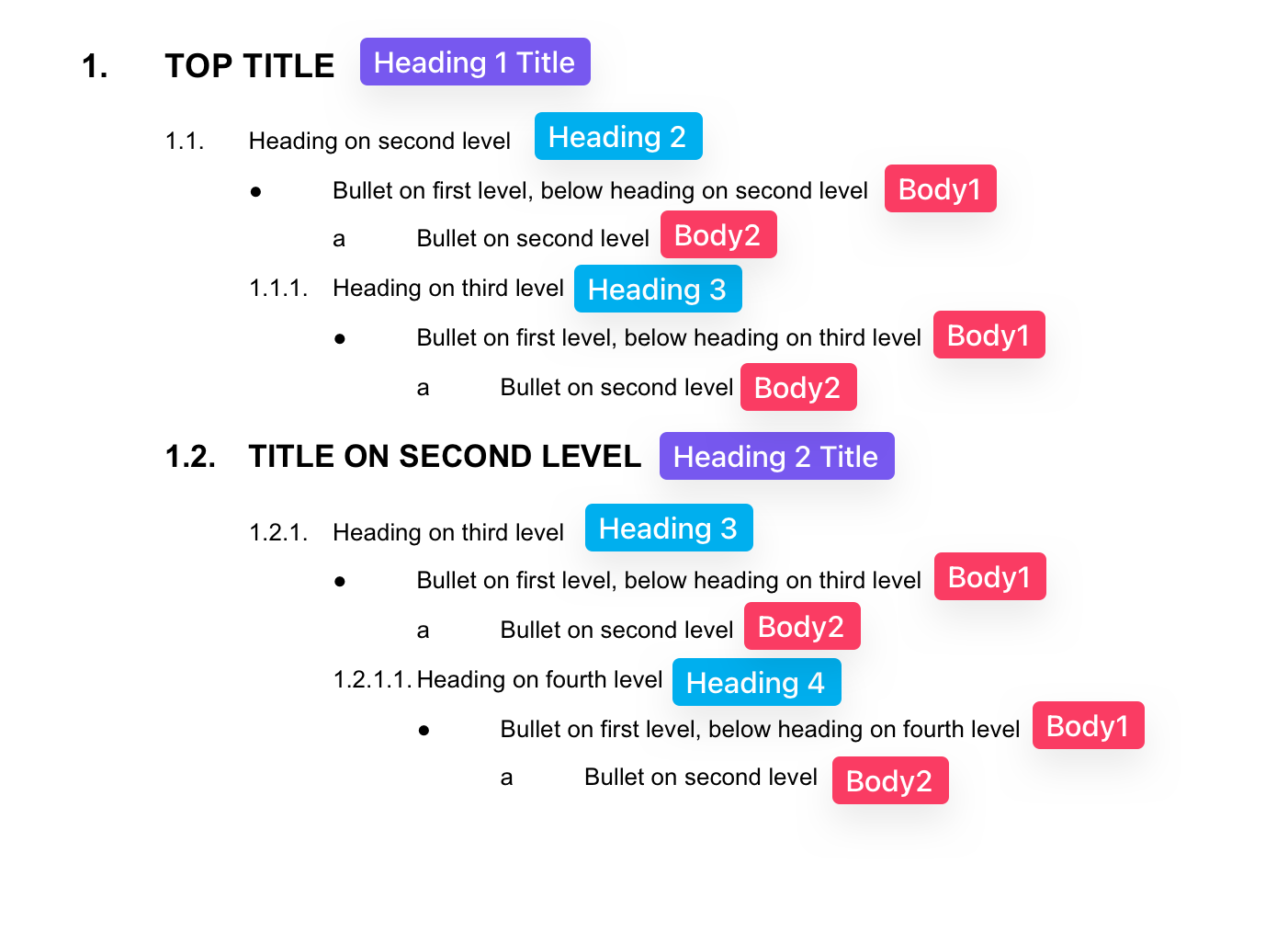
Note that the set of nine body styles is used below each of the title/heading styles, although the indentation can differ. The underlying idea is to have a consistent approach towards bullets, so that if (for example) the first level of bullets is a filled circle and the second level of bullets is (a) (b) (c), those two types of bullets are always used in such way, whether below top-level titles/headings, or instead sub-sub-sub titles. Example:
{% hint style="info" %}
Clauses prepared in **ClauseBuddy** itself can only have one title (i.e. the optional title assigned to it in the designated editor area, when the clause is being edited in ClauseBuddy). However, clauses and Q\&As that were prepared in **Clause9** can have titles in any of the nine levels.
{% endhint %}
---
# Agent Instructions
This documentation is published with GitBook. GitBook is the documentation platform designed so that both humans and AI agents can read, navigate, and reason over technical content effectively. Learn more at gitbook.com.
## Querying This Documentation
If you need additional information that is not directly available in this page, you can query the documentation by asking a question.
Perform an HTTP GET request on the following URL with the `ask` and `goal` query parameters:
```
GET https://help.clausebuddy.com/quality-library/how/in-depth/custom-styling/clausebuddy-layout-structure.md?ask=&goal=
```
`ask` is the immediate question: it should be specific, self-contained, and written in natural language.
`goal` is what the user is ultimately trying to achieve, the reason they need the answer. Sharing it helps GitBook give you a better, more relevant answer. A goal is most helpful when it describes the outcome the user wants rather than restating the question. For example, with `ask=how do I create an API token`, a goal like `automate deployments from our CI pipeline` lets GitBook tailor the answer to that use case.
The response will contain a direct answer to the question and relevant excerpts and sources from the documentation.
Use this mechanism when the answer is not explicitly present in the current page, you need clarification or additional context, or you want to retrieve related documentation sections.