> For the complete documentation index, see [llms.txt](https://help.clausebuddy.com/llms.txt). Markdown versions of documentation pages are available by appending `.md` to page URLs; this page is available as [Markdown](https://help.clausebuddy.com/smart-templates/how/in-depth/smart-templates-in-depth/template-settings.md).
# Template settings
## File & location
### **Folder & filename**
In this section of the template's settings, you can specify the folder where the template will be stored, as well as the filename.
{% hint style="info" %}
While you can easily create new folders right from within this folder section, the other aspects of managing folders (e.g., to move existing folders) can be done through the central settings of ClauseBuddy.
{% endhint %}
### **Template category**
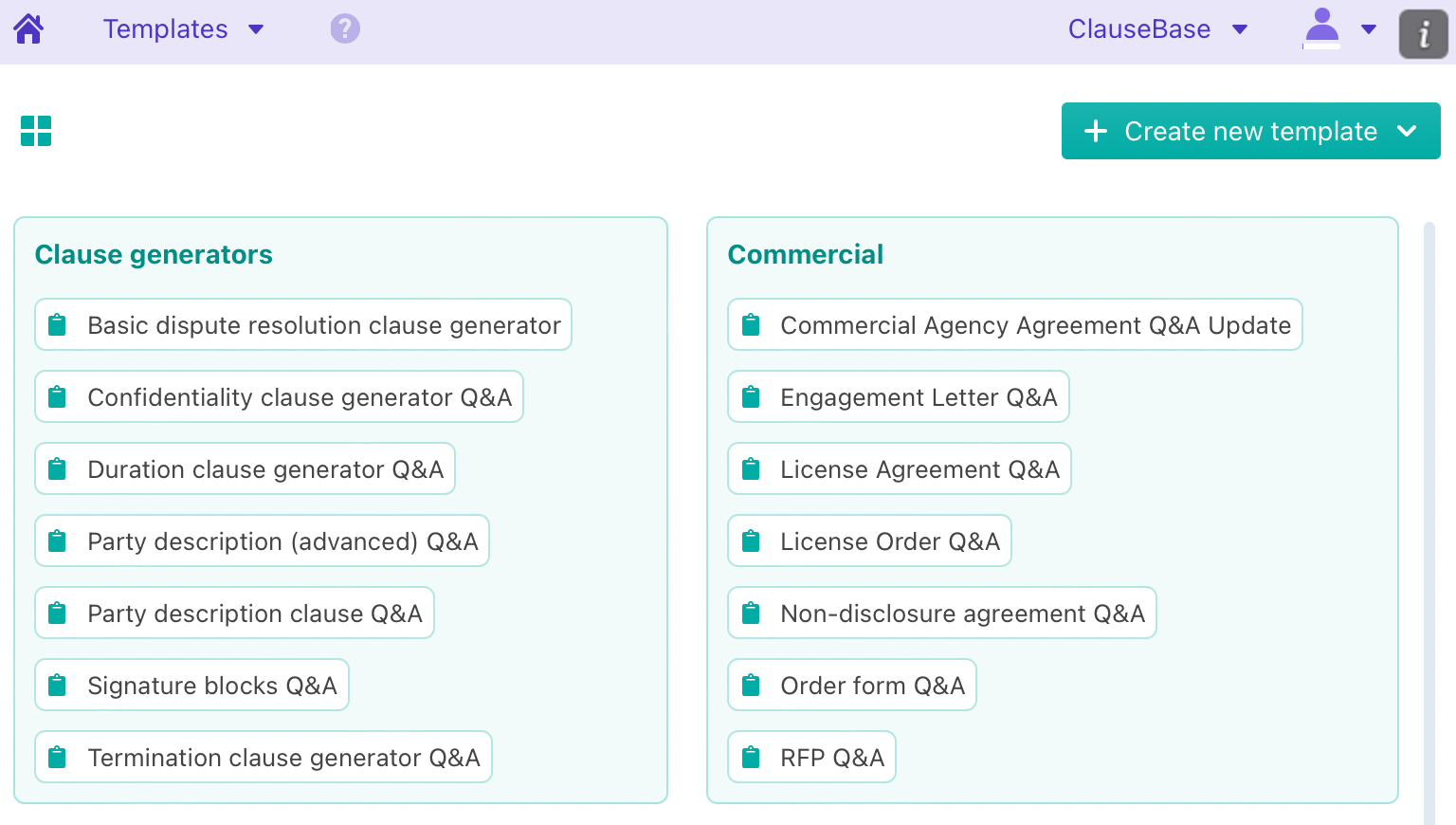
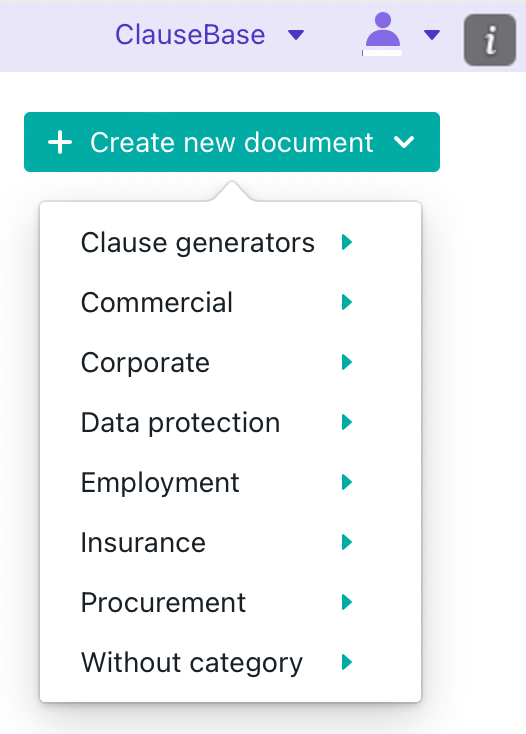
Each template can optionally be assigned a category. Such category can help end-users to quickly choose the right template among a large number of templates.
When categories are assigned to one or more templates, they will be shown on the Templates Overview panel...
... as well as in the dropdown menu at the top right menu of the Documents Overview panel:
## Miscellaneous
### **Card colour**
Here you can define the default colour assigned to cards. Individual cards can deviate from this default colour through their own settings.
### **Indicators for mandatory questions**
This setting allows you to centrally enable/disable the presence of red dots that are shown next to questions marked as mandatory. This will also impact the message *"Some mandatory questions are not answered."* (shown to the end-user at the right side of the template) will also get removed.
## Share
This is discussed on [the next page](/smart-templates/how/in-depth/smart-templates-in-depth/sharing-templates.md).
---
# Agent Instructions
This documentation is published with GitBook. GitBook is the documentation platform designed so that both humans and AI agents can read, navigate, and reason over technical content effectively. Learn more at gitbook.com.
## Querying This Documentation
If you need additional information that is not directly available in this page, you can query the documentation by asking a question.
Perform an HTTP GET request on the following URL with the `ask` and `goal` query parameters:
```
GET https://help.clausebuddy.com/smart-templates/how/in-depth/smart-templates-in-depth/template-settings.md?ask=&goal=
```
`ask` is the immediate question: it should be specific, self-contained, and written in natural language.
`goal` is what the user is ultimately trying to achieve, the reason they need the answer. Sharing it helps GitBook give you a better, more relevant answer. A goal is most helpful when it describes the outcome the user wants rather than restating the question. For example, with `ask=how do I create an API token`, a goal like `automate deployments from our CI pipeline` lets GitBook tailor the answer to that use case.
The response will contain a direct answer to the question and relevant excerpts and sources from the documentation.
Use this mechanism when the answer is not explicitly present in the current page, you need clarification or additional context, or you want to retrieve related documentation sections.